
In short
The first ten clients of a new recruitment agency come, in this order, from people who already know you, from a niche narrow enough that you are easy to place, and from reaching out to companies that are already hiring, started in month two rather than when the network is empty. Entity type, insurance, licensing and contracts need an accountant or an attorney before you start. What follows picks up after that: your offer, your fees, the first names to call and a 90-day plan.
Contents
What do you sell, and to whom, before the first call?
An offer fits in one sentence: which roles, for which employers, in which area, and on what terms you get paid. "Controllers for $30 million to $150 million manufacturers in the Midwest, contingency or exclusive" can be remembered and sold. "All roles, everywhere" speaks to no one.
Choose the niche by crossing three questions. Which candidates could you put together within a week, without posting an ad? Which employers do you know from the inside, through a past career or a region? And where is the work growing? On that last point, public data exists: the Bureau of Labor Statistics projects (2025 to 2035, released August 27, 2026) that health care and social assistance will add more than 2.2 million jobs, 9.5% growth and the largest gain of any major sector, with professional, scientific and technical services next at 8.6%, or 926,700 jobs. A field where candidates apply on their own is a poor field for an agency.
Your starting niche is not permanent. It gives you a way in, and your first clients will tell you where to widen it.
How much should you charge at the start?
Published fee guides put the most common direct-hire fee in North America at 20% of first-year salary (the 2021 Staffing Industry Analysts survey, as reported by Second Talent, which adds that terms published in 2024 to 2026 sit at or above the top of those ranges). In the UK, guides such as get-staffed's (September 2026) put contingency at 15 to 25% and retained searches at 25 to 35%. On a $75,000 salary, 20% is $15,000. Those ranges come from firms that publish their prices, not from an official scale: check what agencies in your specialty actually charge before you set yours.
The beginner's trap is cutting your rate to land a first search. A low rate becomes a reference you cannot raise, and the next client knows it. If you have to give something, give it elsewhere: a shorter exclusivity window, a guarantee period at the lower end of what is common (published US terms often run 60 to 90 days, and UK rebate schedules four to twelve weeks). Put the replacement guarantee in writing before the client signs, because the client will expect one.
Where do the first ten clients come from?
Before you open, write down fifty names: former managers and colleagues who now run teams, former employers you left on good terms, candidates you coached who became managers, owners you met through an association or chamber of commerce. Call the first twenty within two weeks. The message is three sentences: you are starting an agency, here is your specialty, do you have an open role or know someone who does?
If you are leaving a firm to start your own, reread your employment agreement's non-compete and non-solicitation clauses before you call a single former client, and have a lawyer check them.
Your network gets you a few first clients, not ten. The rest come from companies that have never heard of you. The method is to spot the ones with an open role in your specialty, find the person who decides on the hire, and write to them about that role (a recruiting business development email that gets read). The map of all the ways to get clients helps you pick the channels that complement it.
Odyn
Let Odyn prospect while you recruit
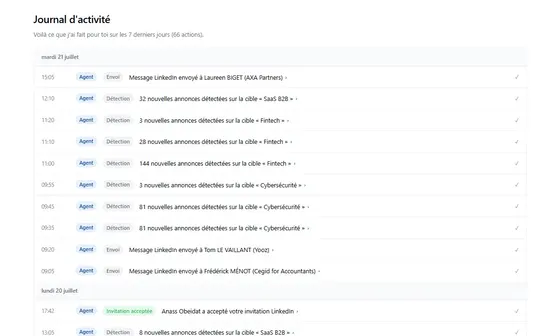
Every day, Odyn spots the companies hiring in your specialty, writes to decision-makers from your own email and LinkedIn account, follows up, and hands the conversation back to you the moment they reply.
See a 15-minute demoA 90-day plan
- Days 1 to 15: lay the groundwork. Write the offer in one sentence. Put your terms on one page (fee, exclusivity, replacement guarantee). Align your LinkedIn profile with the niche. Prepare an anonymized candidate summary template, for the day a hiring manager says "send me someone."
- Days 16 to 45: talk to people who know you. Call the first twenty contacts, hold your first intake calls, sign one or two job orders, even small ones. In parallel, start reaching out to companies with an open role, at a volume you can sustain in the middle of a search.
- Days 46 to 75: widen without scattering. Ask each satisfied client for an introduction, follow up with contacts who went quiet, and note who replies and about which kind of role.
- Days 76 to 90: decide. Look at which companies answered, about which roles, on what terms. Narrow or widen the niche based on what the answers say, not on what you hoped.
By month two the steps are known; the rhythm is what slips, because you also have candidates to find and manage. Part of that work can go to Odyn, the AI prospecting agent for recruitment agencies: it spots companies hiring in your target, finds the decision-maker, writes from your own email address and LinkedIn account, follows up and stops when the decision-maker replies. For a new agency the point to look at is the commitment: the subscription is monthly with no lock-in, so you can stop once the first job orders are enough. Each fellow recruiter you refer then takes 10% off your bill, down to nothing at 10 referrals. See the AI prospecting agent.
Which mistakes cost the first months?
Spending the first month on the website, the logo and the business cards when no hiring manager has been called. Accepting any job order to "get on the board": first ask whether the role is already with another firm, and if so, decline or offer a limited exclusive. Starting a search without a full intake, then submitting candidates the client rejects for reasons nobody mentioned. Not keeping a record of who was contacted, when and with what answer: a spreadsheet will do, as long as you keep it. And believing prospecting can wait until the first searches are delivered: the freelance recruiter guide explains why it is the first thing to go when you are alone, and how to stop that.
Entity, insurance, licensing, contracts: have a professional check
The choice of entity (an LLC or corporation in the US, a limited company in the UK), taxes, professional liability insurance, your terms of business, and any rules that apply to employment agencies where you operate depend on your situation. Some US states license employment agencies, and the UK has its own rules for them, so ask before you advertise. An accountant covers structure and tax, an attorney or solicitor covers contracts and licensing, and a local Small Business Development Center offers free advice on starting up. This page does not give legal advice.
Frequently asked questions
How much cash should I have before the first fee arrives?
Count in months. Between the first call to a client and the fee in your account there is the intake, the search, the submittals, the client's decision, the start date and often the end of the guarantee period. Plan to cover your costs and your own pay for that whole stretch, without counting on the first placement to fund it.
Is this a good time to open an agency?
Not an easy one: the BLS counted 5.2 million US hires in August 2026 (JOLTS), little changed from a year earlier, so nobody is hiring in a rush on your behalf. A new agency has no book of business to defend, though, so it can concentrate where employers struggle to fill roles and an agency adds something.
Do I need a client before I form the company?
That is a question about entity and tax timing, so put it to your accountant. Commercially, nothing stops you from testing your offer with ten owners before you formalize it: their reactions tell you more than a study.
Can I start without a Rolodex?
Yes, more slowly. Without a network, writing to companies with an open role becomes your main channel from the first weeks. You earn credibility through precision: a message naming the role, the city and the profile you know how to find gets read more than a general introduction.
Your next clients are hiring right now.
Odyn, the AI prospecting agent for recruitment agencies, spots companies that are hiring, contacts decision-makers on your behalf, and hands the conversation back to you the moment they reply.
Book a demo15 minutes, no commitmentReferrals: every firm you bring in takes 10% off your subscription, down to paying nothing. See pricing