
In short
An AI prospecting agent is software that runs the whole prospecting chain itself: it finds the companies to contact, finds the person who decides, writes a message for that person, sends it, follows up, and stops when they reply. You set the target and the rules, and it does the rest. That is what separates it from an automation tool, which sends what you wrote, and from a contact database, which tells you whom to write to without writing to anyone.
Contents
Agent, automation tool, database: who does what?
A database supplies names. You filter, you export, and everything else is yours: choosing whom to contact, writing, sending, following up. An automation tool sends messages for you: you bring the list, you write the templates with their merge fields, you set the follow-up schedule. lemlist is a well-known example. It executes very well, but it executes what you prepared.
An agent absorbs both layers and adds judgment: which company deserves a message, which person to address, what to say about this particular role, when to follow up, when to say nothing. Most recruiting firms today assemble a database, a sending tool and a great deal of time; the comparison of Odyn with manual prospecting sets that assembly next to an agent.
Then there is the term "AI SDR," common in searches. An SDR (sales development representative) is the salesperson who qualifies prospects and books meetings, and an AI SDR is an agent that fills that seat for any B2B seller. You describe your offer and your ideal customer, and it finds prospects by company size, industry and location. An agent built for one trade starts from a signal specific to that trade. For a recruiting firm that signal exists and it is public: a company that posts a job has a need that day.
What should you check before choosing one?
Five questions, for every vendor, Odyn included.
- Where do the messages come from? From your own email address and LinkedIn account, or from a domain and a profile the decision-maker has never seen? In the second case you are not the one writing, and the reply lands somewhere other than with you. In the first, the decision-maker sees your name and replies to you. The sending limits to know on LinkedIn are in the guide to LinkedIn automation.
- Does it stop at the first reply? A follow-up that arrives after "yes, call me" is the mistake that hurts a recruiter's reputation most.
- Does it know your trade? A generalist agent has no reason to know that a posting reading "our client, a Midwest manufacturer" already belongs to another firm, or that writing to your own clients is a mistake. Ask what it excludes, and how you give it your clients.
- What does it do with people who decline? Someone who asks not to be contacted should not be, on any channel.
- Can you review before sending? At least at the start: you judge tone and selection on real messages, not on a demo.
An agent that hesitates on any of these five answers will sooner or later write in your name what you would not say.
What an agent will not do
It does not run the scoping call, negotiate your fee, or win the job order. Anything that requires understanding a need, reassuring someone or saying no to an exclusive stays a recruiter's job. A vendor that promises job orders, meetings or a ratio is selling something other than an agent: nobody controls what the decision-maker will answer.
An agent does not replace your knowledge of the market, either. The tighter the target (which roles, which regions, which kind of company), the better it writes. A vague target produces vague messages.
Odyn
Let Odyn prospect while you recruit
Every day, Odyn spots the companies hiring in your specialty, writes to decision-makers from your own email and LinkedIn account, follows up, and hands the conversation back to you the moment they reply.
See a 15-minute demoHow does Odyn work?
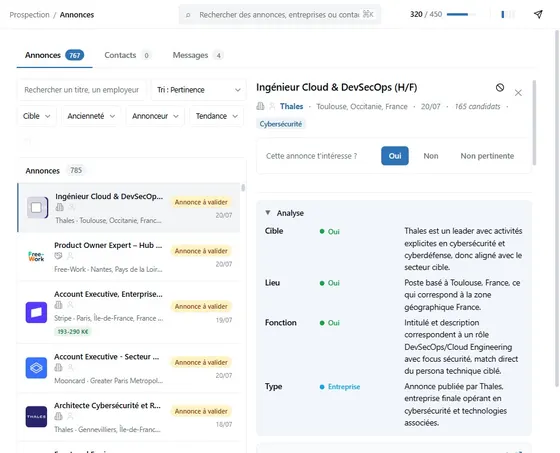
Odyn is the AI prospecting agent for recruiting firms. You describe your target: the roles, the locations, the industry. It goes through the published job postings, drops those that hold no interest for a recruiting firm, and keeps those that match your target (which postings deserve a message). For each one it looks for the person who decides on the hire and their business contact details (whom to write to).
It then drafts a message based on the ad and on your specialty, in your style. It sends from your email address and your LinkedIn account, on business days from 9 a.m. to 6 p.m.: to the decision-maker, you are the one writing. It follows up with restraint until there is a reply, then stops. When a decision-maker accepts your LinkedIn invitation, Odyn suggests that you call. The conversation is yours: Odyn never answers in your place.
For the first three business days after sign-up, you review and approve every message. After that, Odyn sends on its own, after the delay you chose. You give it your list of clients and prospects, which it does not contact, and a person who asks not to be contacted is not contacted again. One feature, in beta, works the other way round: Push CV. You upload a candidate's resume, Odyn anonymizes it and presents it to decision-makers at companies whose postings match.
Who Odyn is not for
A firm whose clients do not post jobs: confidential search, executive roles filled through networks. Odyn starts from the posting, and with no posting it has nothing to read. It is also the wrong fit if you want a channel other than email and LinkedIn, or if you expect it to win job orders for you. And like any tool that acts on a LinkedIn account, it is subject to LinkedIn's position on automation, which you should know before you connect your profile.
If the profile fits, the next step is a 15-minute demo. The other options are gathered in the comparison index, and the place of an agent among your sources of clients is in the guide to getting clients for a recruitment agency.
Frequently asked questions
How much does an AI prospecting agent cost?
Models differ: a per-user price with credits spent on each action, a cost per contact, or a flat subscription. The units do not compare directly, which the pages comparing Odyn with lemlist and with an outsourced SDR spell out. Odyn costs €290 per month per consultant, excl. VAT, with no commitment, for 450 decision-makers contacted per month, by email and on LinkedIn; the annual plan is €2,900 excl. VAT, which is two months free. There is no commission on your placements and no fee per meeting. A decision-maker counts only if a message was actually sent. Details are on the pricing page.
Is there a guarantee?
Yes, and it is limited. If Odyn brings you no connection within your first 30 days (a written reply from a decision-maker or an accepted LinkedIn invitation, not counting automatic replies, invalid addresses and unsubscribes), your subscription is extended free of charge, up to two months. It is not a refund, and it does not promise a job order.
How is this different from using ChatGPT to write my emails?
An assistant writes when you ask, from what you give it. It does not find companies that are hiring, find the decision-maker, send from your accounts, follow up, or know that it must go quiet after a reply. You remain the engine of every step.
Does an agent replace a business developer?
It replaces the repetitive part: finding, writing, sending, following up. It does not replace the conversation with the client, or the relationship over time. The comparison with an outsourced SDR sets the two side by side on price and on what you hand over.
Your next clients are hiring right now.
Odyn, the AI prospecting agent for recruitment agencies, spots companies that are hiring, contacts decision-makers on your behalf, and hands the conversation back to you the moment they reply.
Book a demo15 minutes, no commitmentReferrals: every firm you bring in takes 10% off your subscription, down to paying nothing. See pricing