
In short
Prospecting companies that are hiring means using a posted job as your reason to write to the person who posted it: a specific role, a visible need, someone to talk to. Not every posting is worth a message, and instinct is often wrong about which ones. Odyn wrote to nearly 5,000 job postings between June and October 2026 on behalf of recruiting firms, and the small employers who hire rarely drew about three times more interested replies than the others. How old the posting was showed no clear pattern. Sorting is less about the job than about the employer.
One caveat before the numbers: those postings are mostly French. The behavior of a plant manager in Lyon and one in Greenville, South Carolina, has no reason to differ much, but treat what follows as a hypothesis to test in your own market, not a law.
Contents
Where do you find the postings for a specialty?
LinkedIn, Indeed, ZipRecruiter, Glassdoor, a niche board for your field (Dice for tech, for example), and the careers pages of the employers themselves. Two sources are enough for one specialty. A recruiter who places controllers will find plenty on LinkedIn and Indeed; one who places maintenance technicians will often do better on Indeed and on the careers pages of the plants themselves. Beyond two sources you spend your mornings removing duplicates, because the same posting often runs on four sites, and a hiring manager who gets two messages the same morning quickly works out what they are dealing with.
The market is deep. On the last business day of August 2026, U.S. employers had 7.1 million job openings, against 5.2 million hires during the month, according to the BLS Job Openings and Labor Turnover Survey released on September 29, 2026. And small businesses employ about 46% of U.S. private-sector workers, per the SBA Office of Advocacy's 2026 FAQ. That second figure matters here, as you will see.
Which postings are worth a message?
The ones from a small or young employer that posts rarely, with a short ad. It is the opposite of what catches the eye first, which is the company running ten openings at once.
These observations come from Odyn: the postings it wrote to, for client recruiting firms, between June and October 2026. We count as an interested reply an offer to talk, a request for candidate profiles, or a request for your fee terms. We publish no rates, only gaps. They are trends measured over a few months, and we remeasure them every night.
Who answers most: the employer who rarely hires
An employer with a single posting online over two months produced about three times as many interested replies as other employers. At the other end, one with five or more drew about a quarter as many. The gap points the same way for companies of 20 employees or fewer, and for companies under five years old.
Our reading, which the data does not prove: someone who hires once a quarter has no in-house recruiter and no preferred vendor list, and the person reading your message is the one the open seat is hurting. Small employers are most of the market, not a niche: the SBA counts 99.9% of U.S. businesses as small, meaning fewer than 500 employees.
A reposted job gets fewer replies, not more
Many recruiters read a reposted LinkedIn job as a search that is stalling, which sounds like an opening. In our data reposted postings drew about three times fewer interested replies. The gap rests on few replies, so read it as a tendency to confirm, not a law. Our hypothesis: the serial reposters are mostly large employers, with a talent acquisition team and agencies already in place. A signal that tracks company size is not worth chasing.
The age of the posting says little
By the age of the posting when the message went out, replies moved up and down with no clear pattern: a posting up for three weeks drew about the same replies as one up for three days. Some firms skip "stale" postings, assuming the job is filled. Others pounce on them, assuming the employer is desperate. Our measurements back neither. Just check that the posting is still live the day you write.
What the posting that answers better looks like
Three things point the right way: LinkedIn Easy Apply, which sends applications to the employer directly; the ad naming the person who is hiring; a short text. Others point the other way, and that is where the "we already work with an agency" replies pile up:
- a talent acquisition team named in the posting;
- cadre status or a fixed-days contract (French terms, so you will see them in French postings);
- a large group behind the ad;
- an international scope.
Read them together. A senior role at a 40-person manufacturer is a different animal from the same title at a public company.
Which postings should you skip?
First, the ones another firm posted. A listing that reads "our client, a Midwest manufacturer" has probably been given to a recruiter on a job order, often exclusive, and nobody likes a second firm knocking. Tools such as Mantiks (see Odyn compared with Mantiks) sometimes trace the end client behind a competitor's ad; each firm decides whether that is territory it wants.
Staffing agencies' postings are different: they recruit temporary workers on assignment, not permanent hires. Then there are companies you already know (clients, prospects in discussion, employers where you placed someone and are off-limits), roles outside your specialty, and high-volume hiring your firm does not handle. Writing to a client as if to a stranger damages the relationship faster than any refusal.
Odyn
Let Odyn prospect while you recruit
Every day, Odyn spots the companies hiring in your specialty, writes to decision-makers from your own email and LinkedIn account, follows up, and hands the conversation back to you the moment they reply.
See a 15-minute demoWhen should you write?
As soon as you know to whom. The age of the posting shows no clear pattern in our measurements, and the slow step is not the writing: it is finding the right person, which is covered in how to find the decision-maker behind a posting. A message sent Tuesday at 10 a.m. looks like a recruiter at work. The same one at 11 p.m. on Sunday looks like a script.
The message fits in three sentences: the posting you saw, why you are credible on that profile, one simple offer.
Hello Dana, I saw you are hiring a plant maintenance manager for the Greenville facility. I place maintenance and reliability leaders with manufacturers across the Carolinas. If the search is open to an outside recruiter, I can send you two profiles this week.
Complete templates, with follow-ups, are in the guide to a business development email for recruiters.
What Odyn does with these signals
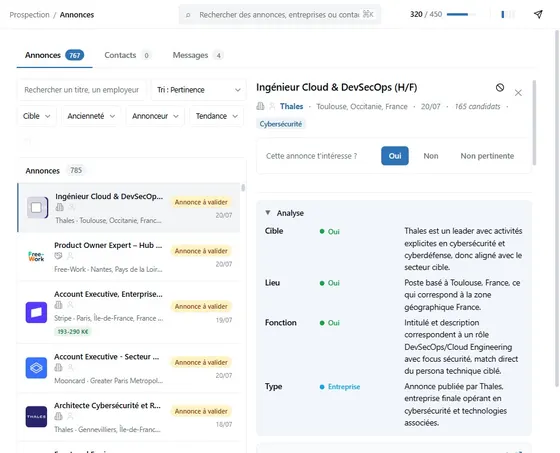
Odyn, the AI prospecting agent for recruiting firms, goes through the job postings in the recruiter's target (roles, locations, industry), drops those a recruiting firm has no use for, and takes the signals above into account when choosing which postings to write to. It then finds the decision-maker, drafts the message from the ad, sends it from the recruiter's own email address and LinkedIn account, follows up, and stops as soon as someone replies. Clients and prospects the firm has given it are excluded. The subscription is €290 per month per consultant, excl. VAT, for 450 decision-makers contacted (pricing). Odyn sorts and writes; the scoping call and the job order stay with you. For where all this fits among your other sources of clients, see the guide to getting clients for a recruitment agency.
Frequently asked questions
Is a staffing agency's posting a target?
Rarely. The agency is looking for temporary workers for an assignment, not a permanent hire you could fill. If the client company interests you, go through the openings it posts under its own name.
What do you say to "we already work with an agency"?
Thank them in two lines and ask one question: is there a role their agency is struggling to fill? If the answer is no, note the date and come back in three months. Pushing against a refusal from a large employer costs more than it earns, and that is exactly where this refusal concentrates.
One message per posting, or one per company?
One per company. If three jobs are open, cite the one closest to your specialty and mention the others in a sentence. Three messages about three roles, to the same person, read like a mailing list.
What about companies that never post?
They exist, mostly in confidential search, and this method cannot see them. Without a posting your message has no subject. For those clients, referrals and your network stay more reliable.
Your next clients are hiring right now.
Odyn, the AI prospecting agent for recruitment agencies, spots companies that are hiring, contacts decision-makers on your behalf, and hands the conversation back to you the moment they reply.
Book a demo15 minutes, no commitmentReferrals: every firm you bring in takes 10% off your subscription, down to paying nothing. See pricing