
In short
In an agency that already has revenue, business development is less a job title than a protected block of time and one person who answers for it. For a firm under ten recruiters, the setup that lasts looks like this: one partner accountable for the flow of new clients, half a day to a full day a week of business development for every recruiter, and a twenty-minute Monday check-in that counts open conversations, not messages sent. A dedicated business developer or an outside provider gets added when that block keeps vanishing every time an urgent job order lands. The other ways to find clients are laid out in how to get clients for a recruitment agency; this page is about running it inside the firm.
Contents
Who should own it?
The founding partner who keeps all of the selling does fine for the first two years, then becomes the bottleneck: everything runs through one calendar, the method lives in one head, and the agency cannot be sold without them. It is the most common setup and the most fragile.
The desk recruiter who sources, sells, and runs the process end to end (the "360" recruiter) gives the client one contact, which is the whole appeal. But prospecting then happens in the evening, which means it does not happen, unless the firm counts it as work time and builds it into pay.
A dedicated business developer protects the time. That person costs a salary and needs raw material: knowledge of the specialty, recruiters who call decision-makers back, enough job orders to sign to justify a full-time seat. An agency of three or four people rarely keeps one busy.
Outsourcing (an SDR service, a freelance appointment setter) starts fast but knows your market poorly. The comparisons Odyn versus an outsourced SDR and Odyn versus manual prospecting put the numbers side by side.
Our view: in a five-person agency, a desk recruiter with a ring-fenced block of time plus a partner who owns the pipeline beats a dedicated hire, as long as the block survives the first urgent job order.
How many hours a week?
Four hours per recruiter is the floor; a full day is better. Below four hours, the cycle of spotting, messaging, following up and calling never closes within the week, and prospecting turns into a string of restarts. The partner who owns the flow of new clients puts in a day, spread across the week.
When workload climbs, cut the block in half, never to zero. An agency that stops for six weeks has no open conversations left when its current job orders end. Prospecting done today is what pays in three months.
What does a week that holds up look like?
Monday: twenty minutes together over the pipeline board, with the next action and date for every open conversation. Tuesday and Thursday mornings: two hours blocked in the calendars of whoever is prospecting, for new messages, follow-ups and scoping calls. Friday: five minutes to note who replied, who declined and why.
The reasons for declining are the most instructive part. "We recruit in-house" says something different from "we already have an agency," and the two call for different messages. A shared spreadsheet or whichever CRM you prefer is enough, as long as everyone fills in the same columns.
What to track in the pipeline
Six stages are enough: company spotted, decision-maker contacted, conversation open, scoping call done, job order signed, placement made. The number that matters is open conversations. A decision-maker who answered, even with "not now, call me in January," is a conversation. Messages sent measures your effort, not your progress, and it is the only one of the two you fully control.
Then watch three transitions: conversation to scoping call, scoping call to signed job order, and the share of signed job orders that are exclusive. Few conversations point to the target or the message. Many conversations without a scoping call point to a weak opener on the phone. Many scoping calls without a signed order point to your terms.
A note for people who follow "buying signals" (funding rounds, executive appointments, government contracts won). In the job postings Odyn contacted on behalf of recruiting firms between June and October 2026, mostly French employers, none of these signals predicted anything clear about interested replies. A change of executive on the company register even leaned downward, because it mostly concerns older, structured companies with settled hiring habits. The job posting itself remained the signal that counts (see prospecting companies that are hiring). These are tendencies measured over a few months, which we remeasure every night.
Odyn
Let Odyn prospect while you recruit
Every day, Odyn spots the companies hiring in your specialty, writes to decision-makers from your own email and LinkedIn account, follows up, and hands the conversation back to you the moment they reply.
See a 15-minute demoHow to pay the person who wins clients
For a US reference point, published compensation guides such as Recruiterflow's describe a base-to-commission ratio of 60:40 as standard, and plans where commission only starts once billings pass a threshold (a multiple of base pay). Those describe recruiters who place candidates, not people who only open doors, so treat them as a starting point for the conversation.
For someone whose job is to sign job orders, tie the variable part to signed job orders and their type (exclusive or not), not to meetings or messages. A person paid per meeting brings you meetings.
Chasing clients or chasing candidates: how to decide
The question comes up the day an urgent job order lands. The rule that avoids the yo-yo: if recruiters are turning down job orders for lack of time, you are short a recruiter, not short of prospecting. If nobody is short of work yet prospecting keeps slipping, the block is not protected, and it needs to go back into calendars instead of being promised again.
What an agent can take over
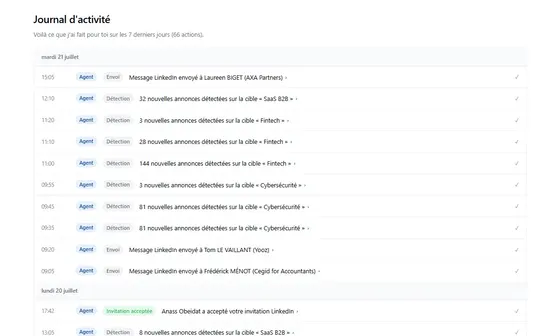
Odyn, the AI prospecting agent for recruitment agencies, takes the part of the cycle that eats the four hours of the desk recruiter: spotting companies that are hiring in the target, finding the decision-maker, writing and sending from the recruiter's own email address and LinkedIn account, then following up until a reply. When a decision-maker replies, Odyn stops: scoping, negotiation and signature stay with the recruiter. The time spent prospecting moves toward conversations, where a recruiter's presence counts most. The subscription is €290 a month per consultant, excluding VAT, with no commitment (see pricing and the AI prospecting agent). For a solo recruiter with no partner to own the pipeline, the freelance recruiter guide takes the same questions down to the scale of one person.
Frequently asked questions
Does a five-person agency need a full-time business developer?
Rarely. The fixed cost weighs heavily, and a narrow target does not generate enough conversations to keep someone busy full-time. Many agencies start with a ring-fenced block of time and a tool, then hire when recruiters begin refusing job orders for lack of time to scope them.
How do you split companies between recruiters without conflict?
Assign the company to the first recruiter who logged it on the tracking board, for a set period (six months, for example), and reassign it if the conversation goes quiet. Write the rule down: disputes come from verbal assignments. If two recruiters target the same company for different roles, agree on who speaks to the decision-maker.
Do we need a CRM?
A shared spreadsheet is enough while the agency tracks under a hundred open conversations. A CRM becomes useful when several people write to the same companies and the history has to be readable at a glance. Whatever the tool, three columns matter: the date of the last action, the next action, and the reason for any decline.
Your next clients are hiring right now.
Odyn, the AI prospecting agent for recruitment agencies, spots companies that are hiring, contacts decision-makers on your behalf, and hands the conversation back to you the moment they reply.
Book a demo15 minutes, no commitmentReferrals: every firm you bring in takes 10% off your subscription, down to paying nothing. See pricing