
In short
Recruitment agencies get clients through eight channels: referrals, past clients, networking, LinkedIn content, phone calls, direct messages to companies that are already hiring, referral partners such as accountants and attorneys, and vendor-list or RFP processes. No single channel carries a small agency. The workable setup is two or three in parallel, including one you trigger yourself every week, because referrals arrive when they want to and dry up the day a client stops hiring. This page is a map: what each channel brings in, when it runs out, and how to choose by firm size and specialty.
Contents
Why waiting for the phone to ring is riskier than it looks
The US market is neither collapsing nor booming. The Bureau of Labor Statistics counted 7.1 million job openings and 5.2 million hires in August 2026 (JOLTS, released September 29, 2026), with hires little changed from a year earlier. Meanwhile the American Staffing Association counts about 27,000 staffing and recruiting companies and close to 54,000 offices in the US (2021 figures). A hiring manager is rarely short of recruiters to talk to.
The harder conversation is price. SHRM's benchmarking put the average cost per hire at nearly $4,700 (SHRM, April 2022). A 20% fee on a $90,000 salary is $18,000, and the CFO will set the two numbers side by side. The most common direct-hire fee in North America is 20% of first-year salary, according to the 2021 North America Staffing Company Survey from Staffing Industry Analysts (42% of firms), as reported in published fee guides. Do not argue about price. Argue time-to-fill and the roles the in-house team has already failed to fill.
Eight channels, one at a time
Referrals from happy clients
This is where the best job orders come from: the client arrives already convinced, which makes the talk about exclusivity and fees easier. It has two weaknesses. You cannot trigger it, and it rewards placements you made six months ago, not what you do today.
Ask on the day the candidate signs, when the client is most grateful, with a specific question: "Do you know another plant manager who is hiring a maintenance director?" beats "Keep us in mind."
Past clients and placed candidates who became managers
A client who has not ordered anything in a year costs you ten minutes to call, and already knows your work. Go through everyone who has signed with you once a quarter, even for a single role. Candidates you placed three or four years ago who now run a team are a second pool, one that almost nobody works.
Both pools run dry. These are people you already served, not a new market.
Networking and events
Chamber of commerce breakfasts, SHRM chapter meetings, industry association conferences, trade shows. Introductions are warm but arrive at the pace of lunches and receptions. Pick a room where your decision-makers actually are (a manufacturing operations conference for an engineering recruiter, not a general job fair) and keep going back. People refer you after the third meeting, rarely after the first.
LinkedIn content
Writing about your market (how long a controller search really takes, what candidates turn down in an offer) builds a reputation and eventually brings inbound messages. Expect months before the first one. It suits an agency that already has a niche; without one you talk to everybody and nobody recognizes themselves. Automated connection requests and messages are a separate topic, covered in LinkedIn automation for recruiters.
The phone
A cold call to a hiring manager still works for a recruiter who is comfortable on it, provided you call about one specific role ("I saw your opening for a maintenance supervisor") and never to "introduce the firm." The phone is best at scoping a job order after a first written exchange. Alone, it eats hours for a handful of people reached.
Companies that are already hiring
A posted job tells you three things: a role is open, a budget exists, and someone is waiting for a solution. It is the channel you trigger yourself, every week, without waiting to be remembered. The order never changes: spot the opening in your specialty, find the person who decides, write them a short message about that role (the recruiting business development email), follow up.
One observation from our own work cuts against the instinct to chase big brands. In nearly 5,000 job postings Odyn contacted between June and October 2026, an employer with a single posting online over two months produced about three times as many interested replies as other employers. Those postings are mostly French, so read it as a direction rather than a US benchmark, and as a tendency measured over a few months. The detail is in prospecting companies that are hiring.
Referral partners
Accountants, employment attorneys, fractional CFOs, PEO advisors, owners of neighboring agencies that do not do your type of search: they meet owners before a role is open. A partner sends few job orders, but good ones. It works if you return the favor, by introducing your own clients when they need an accountant or an attorney.
Vendor lists and RFPs
Large employers and public bodies pick agencies through preferred vendor lists, master services agreements and vendor management systems. Access to volume is real, in exchange for negotiated fees and a heavy paperwork load. Look at it once the agency has a dozen recruiters. Below that, subcontracting to an agency already on the list is a more realistic first step.
Which channels to keep at your size
Alone or with one partner, keep two channels, not three: referrals, made systematic by asking at every placement, and a short weekly block of prospecting companies that are hiring. The freelance recruiter's version covers what changes when you are the only one on the phone, and starting an agency covers the first ninety days.
With three to ten people, someone has to own the flow of new clients: keep the board of open conversations and protect time for it. Recruitment agency business development describes that setup. Beyond that, partners, vendor lists and content come in, and a dedicated hire becomes a real question.
The usual mistake is adding a channel every time another one disappoints. A channel usually takes several months to pay off, and judging it after four weeks means judging it before it had a chance.
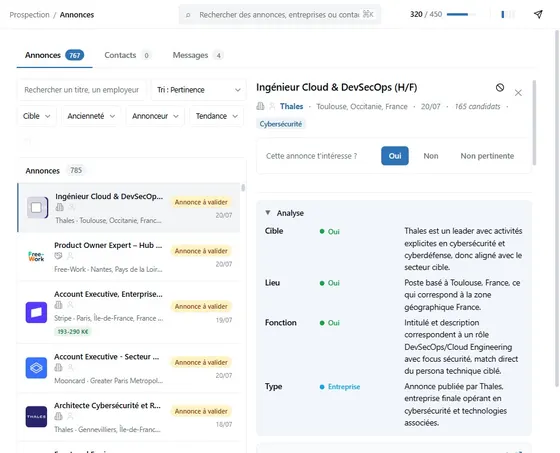
Odyn
Let Odyn prospect while you recruit
Every day, Odyn spots the companies hiring in your specialty, writes to decision-makers from your own email and LinkedIn account, follows up, and hands the conversation back to you the moment they reply.
See a 15-minute demoDoes your specialty change the answer?
The list of channels stays the same, but the most profitable one differs from one specialty to the next. Each has its own page: IT and technology, engineering and manufacturing, accounting and finance, healthcare and construction.
Keeping the Monday channel alive once the job orders arrive
Knowing how to reach companies that are hiring is not the hard part. Doing it again every week, once the job orders arrive, is. Odyn, the AI prospecting agent for recruitment agencies, takes that part: it spots the companies hiring in your target, finds the decision-maker, writes from your own email address and LinkedIn account, follows up, and stops as soon as the decision-maker replies, at which point you take over the conversation. It does not replace your network or your referrals, and it is no use if your clients never post their openings. How it works is described in the AI prospecting agent page.
Frequently asked questions
What do I say when a company says it already has a preferred agency?
Rarely a final no. Ask a question instead of pitching: does that agency also cover hard-to-find profiles, or roles outside headquarters? A preferred vendor often handles the volume roles and leaves out field technicians or specialist searches. Offer to be called for whatever it has not filled after a few weeks, and never criticize the other firm.
Can an agency live on referrals alone?
Some do, usually in a narrow specialty and after several years. The risk shows up as a share of revenue. A common rule of caution is that no single client should exceed a third of the total. It is a convention, not a standard. Above that, two clients freezing hiring is enough to sink the year.
Is it fine to approach a company when another agency posted the job?
If an agency posted it, leave it: you would only duplicate a colleague who is already working the search, and the company will see it. When the employer itself posted the role, the field is open.
Do I need a website before contacting companies?
An up-to-date LinkedIn profile weighs more: the hiring manager looks at who is writing before answering. A three-page site (your specialty, how you work, your terms) is enough at the start. It does not replace a conversation.
Your next clients are hiring right now.
Odyn, the AI prospecting agent for recruitment agencies, spots companies that are hiring, contacts decision-makers on your behalf, and hands the conversation back to you the moment they reply.
Book a demo15 minutes, no commitmentReferrals: every firm you bring in takes 10% off your subscription, down to paying nothing. See pricing