
In short
An IT recruiting firm earns its fee on the searches an employer has already failed to fill: an engineering role open for weeks, a hiring manager who has run out of referrals, a pipeline of applicants who all miss the same skill. Business development therefore means writing to the person who owns that headcount (the CTO, the VP of Engineering, the engineering manager) rather than to HR, naming the role and the stack. What changes the answer you get is who you are compared with: a contract shop, a freelancer, an employee referral.
Contents
Where is the need you can actually bill for?
Demand for tech talent is still growing on paper. The Bureau of Labor Statistics projects 10 percent growth for software developers, QA analysts and testers between 2025 and 2035, with about 106,100 openings a year and a median wage of $134,040 (BLS Occupational Outlook Handbook). Information security analysts are projected to grow about 21 percent over the same decade, at a median of $129,180 (BLS). A hard-to-fill role at that pay level is where a placement fee starts to look reasonable to a hiring manager.
One number shapes where you should look. According to CompTIA's State of the Tech Workforce 2026, roughly 60 percent of tech workers are employed outside the tech industry itself (CompTIA). Your best prospects are not only software companies. A regional bank hiring its first cloud security engineer, a logistics company building a data team in Memphis, a hospital system replacing an integration lead: these employers have no engineering bench to recruit from and few internal recruiters who understand the stack.
Our own data adds a caution on how to pick postings. It comes from job ads Odyn wrote about between June and October 2026, mostly French ones, so treat it as a pattern rather than a US benchmark. In that sample, how long an ad had been open made no clear difference to the share of interested replies, while an ad with LinkedIn Easy Apply (the employer receives applications itself) and an ad naming the person hiring tended to do better. The detail is in the guide to prospecting companies that are hiring. These are trends measured over a few months, which we re-measure every night.
Who signs off on a tech hire?
At a startup of fewer than 100 people, the CTO or a founding engineer decides, usually alone. In a mid-size software company, the VP of Engineering approves the headcount, the engineering manager defines the role and talent acquisition runs the process. Once you reach a large enterprise, a bank or an insurer, the business case comes from a director or VP of a domain (data platform, infrastructure, applications), but procurement and HR often route agencies through a preferred-supplier list or a vendor management system, and an agency without a seat on it gets sent there. Security is the exception: the CISO frequently talks to search firms directly.
An independent recruiter rarely gets onto an enterprise supplier list by a cold message. A 150-person company with no vendor panel and a CTO who still reads their own email is a better first target, and the fee gets less haggling. Finding the hiring decision-maker explains how to reach that person.
What do hiring managers compare you to?
The first alternative is the contract shop: a firm that bills a developer by the hour. A manager under deadline will prefer a contractor starting in two weeks to a permanent hire arriving in four months. Your answer is that a contractor leaves and takes the system knowledge with them, while a permanent engineer stays and builds on it. Contract-to-hire is the middle ground, and some of your searches will end there.
The second is the freelancer from a marketplace, who has no placement fee but also no commitment to stay. The third, and the hardest to beat for senior engineers, is the employee referral: the best candidate usually knows someone on the team. Do not fight referrals. Sell what they cannot reach, which is the engineer who knows nobody at the company, the niche where the team has no network, or the third hire after the first two have used up everyone's contacts.
A first message to a CTO
Engineering leaders spot a template in one line. Name the role, the stack and what the vacancy costs them, and do not ask for an exclusive search in the first sentence.
Hi Karim, I saw you're looking for a senior DevOps engineer (Kubernetes, AWS) since September. I only recruit cloud and infrastructure engineers, who rarely answer job postings. If the role is still open, I can introduce two or three people I'm already talking to. Do you have ten minutes on Thursday?
No promised timeline, no statistic, no paragraph about your firm. On LinkedIn, in our French sample, a short invitation followed by a message produced about twice as many interested replies as email, which brought mostly refusals (LinkedIn automation for recruiters). Email stays useful for the leader you cannot reach on LinkedIn. If you write to US employers, the FTC's CAN-SPAM guide applies to B2B email too: a truthful subject line, your physical address, and a working opt-out honored within 10 business days. The rest of the craft is in writing the business development email.
Odyn
Let Odyn prospect while you recruit
Every day, Odyn spots the companies hiring in your specialty, writes to decision-makers from your own email and LinkedIn account, follows up, and hands the conversation back to you the moment they reply.
See a 15-minute demoObjections you will hear
"We already have two agencies on the role." Ask whether either has submitted someone for this specific job, and when. If the posting has been open for weeks, the answer is usually no. "A contractor can do it." Point out that the role is permanent and the knowledge would leave with the contractor. "Your fee is high." Compare it to what two or three months of an empty seat costs the team, not to annual salary. And when you hear "just send me resumes," do not send a batch: offer a ten-minute intake call on the stack and the salary band, then submit two or three candidates.
When to reach out
Tech hiring is rarely seasonal in the strict sense, but budgets move. Expect approvals in January and September, and slow replies in the last two weeks of December and in August. The best moment is still the posting itself: write within a few days of its publication, before the hiring manager has already heard from three agencies.
Setting up Odyn for a technical niche
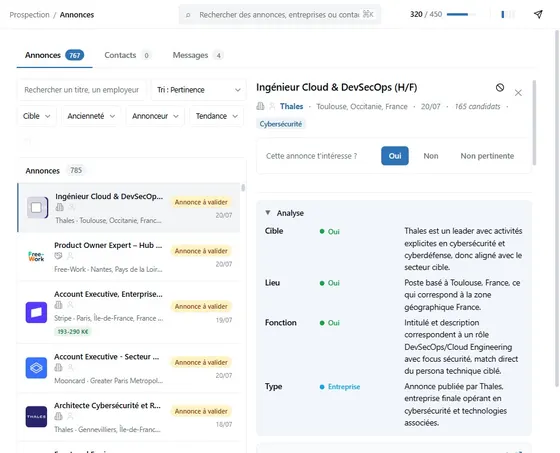
Odyn starts from the job posting, finds the person named on the posting or the technical decision-maker, writes the message around the role and stack in the ad, and sends it from your own email and LinkedIn account. It drops postings published by other recruiting firms and staffing agencies by default, since those are not employers. Create one target per sub-specialty (security in one, data in another) rather than a single "IT" target that blurs them. For the first 3 business days you review every message; after that Odyn sends on its own after the delay you chose, and stops as soon as a decision-maker replies. Contract shops stay among the companies Odyn contacts by default; if you consider them competitors, say so in the target's exclusion field. Odyn's data comes mostly from French job postings, so check coverage for your region before you rely on it for US searches. The full picture is on the AI prospecting agent page and the pricing page (€290 per month per consultant, excluding VAT). For where this fits in your overall pipeline, start with how to get clients for a recruitment agency; if your firm also places accountants, the finance recruiting page covers a different set of buyers.
Frequently asked questions
Can a generalist firm position itself in IT?
Yes, but the first message has to show you speak the language of the role. Pick one family (cloud, data, security) and put it in the opening line. A CTO will not answer a firm that "recruits across all industries."
Should I target startups or large enterprises?
Companies of 50 to 500 people are easier to reach: the technical decision-maker is accessible, there is no vendor panel and decisions move fast. Large enterprises pay well but usually require an approved-vendor status that a cold message rarely delivers.
Do I need to be technical to be credible?
You need to tell an SRE from a backend developer, know the difference between Kubernetes and Terraform, and ask the right intake questions. Nobody expects you to write code, but a hiring manager hangs up once they sense a recruiter who confuses Java and JavaScript.
Your next clients are hiring right now.
Odyn, the AI prospecting agent for recruitment agencies, spots companies that are hiring, contacts decision-makers on your behalf, and hands the conversation back to you the moment they reply.
Book a demo15 minutes, no commitmentReferrals: every firm you bring in takes 10% off your subscription, down to paying nothing. See pricing