
In short
A cold email from a recruiting firm is five or six lines long. It goes to the person who lives with the open role, names that role, says in one sentence why you know this kind of search, and asks for one small thing: ten minutes on the phone, not a job order. Your fee, your references and your brochure wait until someone has answered you.
Contents
- A subject line that looks like a note, not an offer
- Three emails for three situations
- How many follow-ups, and how far apart?
- Who should you send it to?
- Why does your email sometimes land in spam?
- What do the rules say about cold email to employers?
- What Odyn does with this email
- Frequently asked questions
A subject line that looks like a note, not an offer
On a phone, only a few words of the subject line show, and that is what decides whether the email gets opened. Name the role and the place: "Your Production Manager opening in Greenville," "Plant maintenance lead, Columbus site." The reader recognizes their own problem before they work out who is writing.
"Partnership opportunity" and "Staffing solutions for your company" file the message under sales pitches before the first line. All caps and exclamation points finish the job.
Three emails for three situations
These show a structure, not text to copy: a reader who recognizes a template does not reply. Each one also assumes that what it claims is true.
A job posted a few days ago
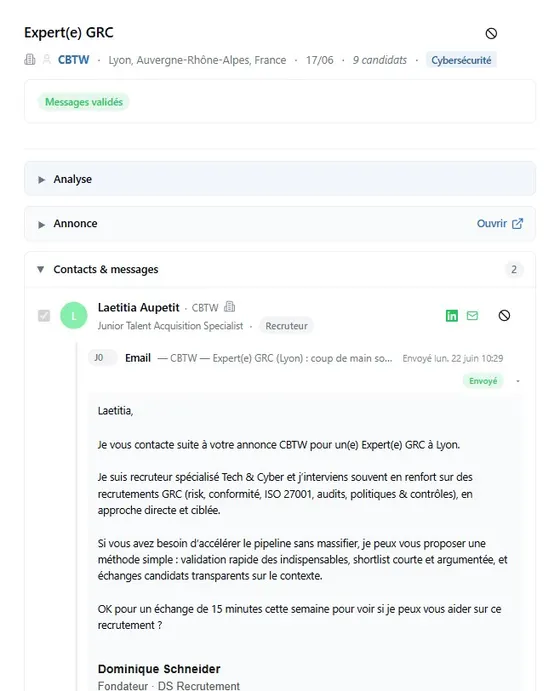
Subject: Your Production Manager opening in Greenville Hello Mr. Reynolds, Your Production Manager posting went up on Monday. I place plant leadership in injection molding and metal fabrication across the Carolinas, and I've done it for eight years. Two people I know fit the role and don't answer job ads. I can introduce you to both by the end of next week, no commitment. Do you have ten minutes Thursday or Friday so I can understand what you need? Best, Helen Garner, Garner Industrial Search, (864) 555-0142
"I'm a recruiter who specializes in manufacturing" proves nothing. "Eight years placing plant leadership in the Carolinas" can be checked in one LinkedIn search, and that possible check is what makes it believable. Offering two people is the core of the message: it tells the manager he can save time, without mentioning what it costs.
Write "two people I know" only if it is true. A plant manager who says "send them over" and gets an empty promise will not answer you again.
A rare profile to offer
Subject: HVAC design engineer available in Denver this summer Hello Sandra, I'm in touch with an HVAC engineer with fourteen years of experience, seven of them designing high-performance commercial buildings, who is considering leaving his current firm within six months. He lives in Aurora and does not want to relocate. Your careers page lists design roles at your engineering office. If this profile is of interest, I'll send his anonymized summary today. Would you like to see it? Best, Kevin Brooks, (303) 555-0187
This one works when a company has no posting, or a posting that does not tell the whole story. It saves the manager a search, which is exactly what a firm sells. Two precautions: the candidate has agreed to be presented, and the summary is truly anonymous. A fourteen-year HVAC engineer in a mid-sized city whom anyone can identify in two clicks is not anonymous.
The follow-up
Hello Mr. Reynolds, A little more on what I mentioned. One of the two works in injection molding today and knows your process. The other comes from precision machining and has run a team of forty operators. Want me to send what each has done over the last five years, without names?
Sent in the same thread as the first email, four business days later. A follow-up with nothing new in it ("just circling back") only reminds the reader that they did not read the first one. This one gives specifics and asks a question that can be answered in a word.
How many follow-ups, and how far apart?
Three emails in all: the first, a follow-up four business days later, and a last one ten business days after the first. The last gives an easy exit: "If the search is with another firm or already filled, tell me and I'll stop writing about it." It often teaches you something, and it keeps you from chasing a role that is already filled.
Stopping after one email is tempting. In Belkins' study of 7.5 million B2B cold emails sent in 2025, the first email in a series produced 41.4% of replies, the follow-ups 58.6%, and more than half of the meetings booked by email came from messages three to five. Those figures cover general B2B sales emails, not recruiting, but the direction is clear: stopping at one email leaves most of the replies on the table.
After three emails, stop, unless you have something new, such as another posting from the same company a month later. A fourth follow-up with nothing new, in a market where hiring managers talk to each other, hurts your reputation more than it gets you a meeting. Whatever the answer, even "we hire in-house," the follow-ups stop.
Who should you send it to?
The hiring manager, or the owner of a small company. Writing to the HR department of a large corporation does not work for an independent: the message gets filtered, and the stock answer is "we already have preferred vendors." Among the more than 2,000 decision-makers Odyn wrote to between June and September 2026, operations leaders and owners gave about four times more interested replies than in-house recruiters, at equal numbers. Those figures come mostly from French job postings. Finding the hiring decision-maker describes how to find the right person.
Choosing the company matters as much as choosing the recipient. Employers that hire rarely answer better than those that hire all the time, which prospecting companies that are hiring covers in detail.
Odyn
Let Odyn prospect while you recruit
Every day, Odyn spots the companies hiring in your specialty, writes to decision-makers from your own email and LinkedIn account, follows up, and hands the conversation back to you the moment they reply.
See a 15-minute demoWhy does your email sometimes land in spam?
First, because the message does not come from where it says it comes from. Gmail and Yahoo check that the sender's domain has proved its identity with three technical records, SPF, DKIM and DMARC, published by whoever manages your firm's domain. Since February 2024, Google requires at least SPF or DKIM from every sender writing to Gmail addresses; above 5,000 messages a day it adds DMARC, one-click unsubscribe and a spam complaint rate under 0.3%. Yahoo sets comparable requirements for bulk senders. A recruiting firm sends far less, so the bulk rules do not apply to it, but authentication matters to everyone. A free checker such as mail-tester.com shows in a minute what is missing.
Second, because the sender has a poor reputation, or none. A recent domain, even perfectly authenticated, has no history to show the filters. Send from the usual mailbox of a real recruiter, the one already used with clients and candidates, not from a domain bought last week.
Third, because the sending looks like a blast. A mailbox that usually sends ten messages a day and fires off two hundred on a Tuesday at 9:02 flags itself. Spread them out: about fifteen a day, during office hours, ramping up gradually. Keep the first message in plain text, with no image, no attachment and at most one link.
What do the rules say about cold email to employers?
In the United States, CAN-SPAM covers business email too. The FTC's CAN-SPAM guidance for businesses says the law "makes no exception for business-to-business email." It asks for accurate sender information, a subject line that reflects the content, a valid postal address, a clear way to opt out, and opt-outs honored within 10 business days. The same page lists penalties of up to $53,088 per violating email, an amount the FTC adjusts for inflation every year. In practice, sign with your name, firm and postal address, and end with an exit line: "If this isn't relevant, just reply and I won't write again."
In the United Kingdom, the ICO's business-to-business marketing guidance says the email marketing rules of PECR do not apply to corporate subscribers such as limited companies, but do apply to sole traders and some partnerships, which are treated like individuals. UK GDPR still applies to a named business contact, and everyone has the right to object to direct marketing.
These are reference points, not legal advice. If you are unsure about your situation, ask a lawyer. A person who asks not to be contacted is not contacted again, on any channel.
What Odyn does with this email
Odyn, the AI prospecting agent for recruiting firms, starts from the published job posting, writes the email for the decision-maker on that hire in the recruiter's own style, and sends it from the recruiter's mailbox, on business days from 9 a.m. to 6 p.m. Sending starts gently: over the first six days, the mailbox's daily cap climbs in steps. Odyn follows up, then stops at the first reply and never answers in the recruiter's place; the recruiter reviews every message for the first three business days.
In the messages sent for its clients from June to October 2026, email and LinkedIn invitations got about the same number of decision-makers to reply, but LinkedIn produced about twice as many interested replies: email replies are mostly refusals, most often "we hire in-house." Those are trends measured over a few months, which we re-measure every night, on postings that are mostly French. They argue for using both channels together, and LinkedIn automation for recruiters explains how to pace the second one. Pricing is public.
To fit email into a full approach to winning clients, see how to get clients for a recruitment agency.
Frequently asked questions
Should I use the decision-maker's first name?
In the United States, yes, from the first message: "Hello Ryan" is normal even with a plant director. In the United Kingdom, a surname with Mr or Ms is safer for older or more formal industries. If the person replies by first name, follow.
What time and day should I send?
During the recipient's working day, on a weekday. No solid study names a magic slot for recruiting, and the difference comes less from the hour than from spreading: fifteen messages across the day beat two hundred at 9 a.m.
Can I write to several people at the same company?
One at a time. Two messages at once, to the engineering director and the HR head, look like a blast, and the second person will tell you "X handles that." If the first stays silent after your three emails, write to the second from a different angle.
Should I call after the email?
Yes, when you have a work number, after the first follow-up rather than after the first message. A call lands better on top of an email already read: you can say "I wrote Tuesday about your Production Manager opening," and the person knows what you mean.
Your next clients are hiring right now.
Odyn, the AI prospecting agent for recruitment agencies, spots companies that are hiring, contacts decision-makers on your behalf, and hands the conversation back to you the moment they reply.
Book a demo15 minutes, no commitmentReferrals: every firm you bring in takes 10% off your subscription, down to paying nothing. See pricing